Manuel Jose Marte, Ph.D., CCC-SLP
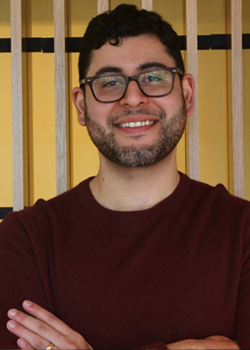
Manuel Jose Marte is a Postdoctoral Research Fellow in the Department of Neurology at Johns Hopkins University School of Medicine and a certified speech-language pathologist. He completed his Ph.D. in Speech, Language & Hearing Sciences at Boston University, where his dissertation work used a movie-viewing paradigm to examine how language, emotion, and visual attention interact in naturalistic contexts in post-stroke aphasia (P.I.: Swathi Kiran; co-PI: Einat Liebenthal, McLean Hospital). Manuel received an M.S. in Communication Disorders from SUNY New Paltz and a B.A. in Speech and Hearing Science from the University at Buffalo. Before his doctoral training, he was a speech-language pathologist specializing in traumatic brain injury and stroke neurorehabilitation at the Northeast Center for Brain Injury and Rehabilitation.
Research
His research focuses on improving outcomes for adults with neurogenic language disorders by developing predictive models of recovery, designing naturalistic paradigms that capture real-world communication demands, and examining how theories of language disorders can better reflect multilingual populations. Methodologically, his work spans behavioral, physiological, and neuroimaging measures (e.g., eye-tracking, fMRI) and computational approaches including machine learning and natural language processing.
Publications
| Russell-Meill M, Marte MJ, Carpenter E, Kiran S. Navigating the Complexity of Bilingual Aphasia: Current Insights and Future Directions. Brain Sciences. 2025; 15(9):989. https://doi.org/10.3390/brainsci15090989. Link. |
| Scimeca M, Peñaloza C, Carpenter EA, Marte MJ, Russell-Meill M, Kiran S. The evolution of word retrieval errors during semantic feature-based therapy in bilingual aphasia. Bilingualism: Language and Cognition. 2025 Aug 11:1-8. Link. |
| Russell-Meill M, Carpenter E, Marte MJ, Scimeca M, Peñaloza C, Kiran S. Measurement of cross-language and cross-domain generalization following semantic feature-based anomia treatment in bilingual aphasia. Neuropsychological Rehabilitation. 2025 Jun 26:1-27.. Link. |
| Peñaloza C, Marte MJ, Billot A, Kiran S. Cross-language interaction during sequential anomia treatment in three languages: Evidence from a trilingual person with aphasia. Cortex. 2025;189:107-30.. Link. |
| Marte MJ, Carpenter E, Scimeca M, Russell-Meill M, Peñaloza C, Grasemann U, Miikkulainen R, Kiran S. Machine Learning Predictions of Recovery in Bilingual Poststroke Aphasia: Aligning Insights With Clinical Evidence. Stroke. 2025 Feb;56(2):494-504.. Link. |
| Marte MJ, Russell-Meill M, Carvalho N, Kiran S. Charting the Course of Aphasia Recovery: Factors, Trajectories, and Outcomes. Annual Review of Linguistics. 2025 Feb 3;11(1):111-36.. Link. |
| Cordella C, Marte MJ, Liu H, Kiran S. An introduction to machine learning for speech-language pathologists: concepts, terminology, and emerging applications. Perspectives of the ASHA Special Interest Groups. 2025 Apr 1;10(2):432-50.. Link. |
| Marte MJ, Addesso D, Kiran S. Association Between Social Determinants of Health and Communication Difficulties in Poststroke US Hispanic and Non-Hispanic White Populations. American Journal of Speech-Language Pathology. 2024 Jan 3;33(1):248-61.. Link. |
| Marte MJ, Peñaloza C, Kiran S. The cognate facilitation effect on lexical access in bilingual aphasia: Evidence from the Boston Naming Test. Bilingualism: Language and cognition. 2023 Nov;26(5):1009-25.. Link. |
| Marte MJ, Carpenter E, Falconer IB, Scimeca M, Abdollahi F, Peñaloza C, Kiran S. LEX-BADAT: Language experience in bilinguals with and without aphasia dataset. Frontiers in Psychology. 2022 Jun 13;13:875928.. Link. |